Spam emails are getting harder to avoid. Many websites still require an email address before you can download a file, claim a discount, access a trial, or create an account. That is why temporary email services remain popular in 2026, especially for users who need a quick temporary inbox, a short-term 5-minute email, or a more flexible burner email solution.
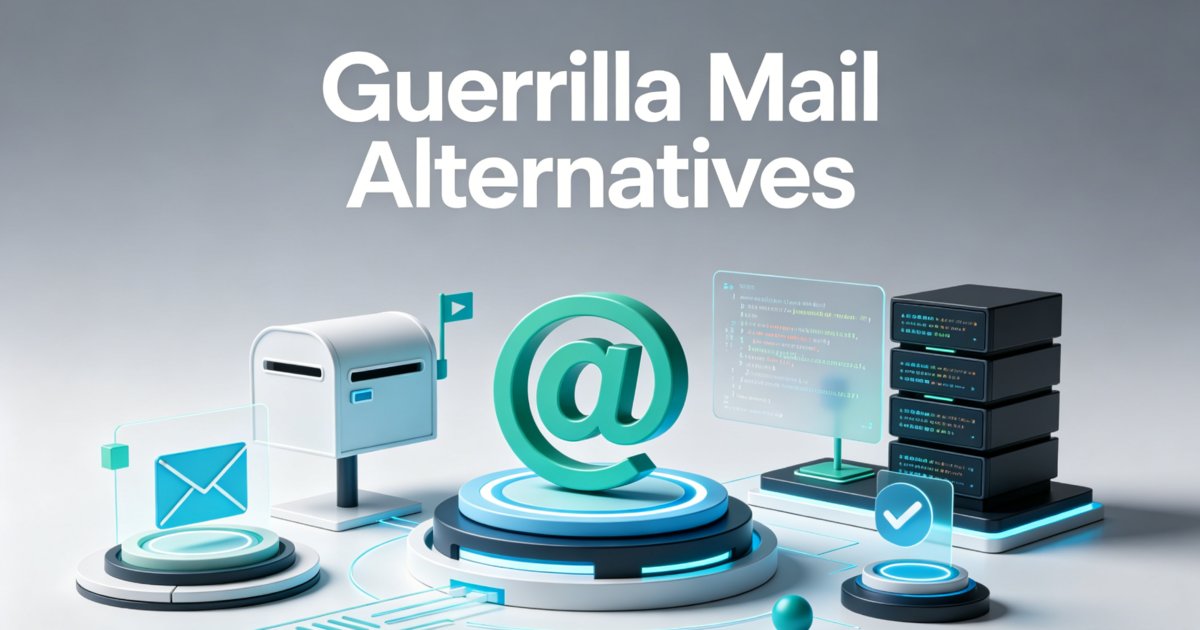
For years, Guerrilla Mail has been one of the most recognized temp mail providers. It is free, easy to use, and requires no registration. However, many users are now looking for a better Guerrilla Mail alternative because of blocked domains, outdated design, inconsistent deliverability, and limited privacy features.
In this guide, we tested and compared the best Guerrilla Mail alternative options available today. Whether you need a disposable inbox for a quick signup, a privacy-focused burner email, or a long-term email alias solution, you'll find a suitable option below.
What Is Guerrilla Mail?
Guerrilla Mail is a disposable email service that allows users to generate temporary inboxes without creating an account. Instead of exposing your real email address to unknown websites, you can use a temporary address to receive verification emails and registration confirmations.
This type of service falls under the broader category of disposable email services, which are commonly used to reduce spam and protect user identity online.
The service became popular because it was simple and anonymous, allowing users to instantly create temporary inboxes for quick signups.
However, in recent years, many websites have started detecting and blocking disposable email domains, which has led to the rise of more advanced privacy-focused alternatives.
As a result, many users are now searching for a more reliable Guerrilla Mail alternative.
Why People Are Looking for a Guerrilla Mail Alternative
While Guerrilla Mail still works for many use cases, several limitations have become more noticeable in recent years.
Registration Success Rates Are Less Reliable
One of the most common complaints among users is domain blocking. Many websites maintain databases of known disposable email providers. When a domain becomes widely used, it often ends up on these blocklists.
This means you may generate a temporary email address successfully, only to discover that the website refuses to accept it during registration.
User Expectations Have Changed
Disposable email users no longer want only a temporary inbox.
Today, many people want:
- Multiple identities for different websites
- Better spam management
- Longer inbox retention
- Email forwarding
- Alias-based privacy protection
These features were rarely expected a decade ago but are increasingly common among modern competitors.
Privacy Standards Have Improved
Privacy-conscious users are becoming more selective about how their data is handled.
Modern alternatives often provide:
- Better transparency
- Stronger security practices
- Improved anti-tracking protection
- More control over inbox lifespan
Key Features to Look for in a Temporary Email Service
Not all temporary email services are created equal. Some are designed for quick one-time signups, while others focus on long-term privacy protection or developer workflows. Before choosing a Guerrilla Mail alternative, consider the following features carefully.
Deliverability
A temporary email address is only useful if it can reliably receive messages. Many websites actively block disposable email domains, so services that maintain a large pool of domains generally offer better success rates.
When evaluating a provider, test whether it can receive verification emails from popular platforms such as social networks, SaaS tools, and e-commerce sites. A service with strong deliverability can save you significant frustration, especially if you frequently create new accounts.
Inbox Retention
Different providers handle inbox lifespan differently. Some automatically delete emails after a few hours, while others allow inboxes to remain active for days, weeks, or even indefinitely.
Think about how long you may need access to the messages you receive. If you're signing up for a free trial that requires follow-up verification later, an inbox that disappears after a few hours may not be practical.
Privacy Protection
Review how a provider handles:
- Data collection
- Email storage
- Tracking prevention
- Encryption practices
Privacy-focused services tend to be more transparent about these policies.
Multiple Addresses
The ability to create multiple temporary email addresses can be extremely useful. For example, you might want separate inboxes for software testing, online shopping, newsletters, and promotional offers.
Using different addresses for different activities also makes it easier to identify which websites share or sell your email information. If spam starts arriving in a specific inbox, you'll immediately know its source.
Email Aliases
Alias-based services work differently from disposable inboxes.
Instead of creating temporary mailboxes, they generate unique forwarding addresses that protect your real email.
For users managing many online accounts, aliases often provide better long-term privacy than disposable inboxes.
Domain Variety
Many websites maintain lists of blocked disposable email domains. If a provider only offers a handful of domains, you may encounter registration failures more often.
Services that regularly rotate domains and provide multiple options typically have higher signup success rates. This is especially important if you use temporary emails for testing new platforms or accessing free trials.
Attachment Support
Not all temporary email services can receive attachments. Some only support basic text emails, while others allow users to view or download files sent to the inbox.
If you expect to receive invoices, documents, PDFs, or software download links, attachment support becomes an important consideration. Always check this feature before relying on a service for anything beyond simple verification emails.
How We Tested These Tools
To identify the best Guerrilla Mail alternatives, we evaluated each service using the same testing framework.Testing was conducted in May 2026 using standard residential connections, without VPN or automation tools, to reflect typical user conditions.
Testing Categories
| Test Area | What We Evaluated |
|---|---|
| Registration Success | Acceptance on popular websites |
| Delivery Speed | Time required to receive verification emails |
| Domain Availability | Number and variety of active domains |
| Privacy Features | Data protection and anonymity controls |
| Inbox Management | Retention, organization, and usability |
| Mobile Experience | Mobile browser usability and responsiveness |
| Long-Term Value | Suitability beyond one-time registrations |
Real-World Testing (Experience-Based Validation)
In addition to feature-based evaluation, we conducted hands-on testing using real signup workflows across multiple types of platforms to measure actual deliverability and domain acceptance behavior.
We tested signup flows on:
- AI SaaS tools (e.g., productivity and AI writing platforms)
- Productivity apps (account-based collaboration tools)
- Community platforms (forums and social registration systems)
- Software trial systems (freemium SaaS onboarding flows)
- E-commerce services (discount access and checkout gating pages)
Rather than relying on theoretical feature comparisons, we observed how each service performed under real account creation conditions, including whether verification emails were successfully delivered and whether domains were accepted or blocked.
Key Observation From Testing
We found that performance varied significantly depending on the type of platform:
- SaaS and productivity tools showed the highest variation in domain blocking behavior
- Community platforms were more tolerant of disposable email domains
- E-commerce and discount-gated pages were the most sensitive to known disposable providers
Among all tested tools, TempEmail.cc and Temp-Mail.org consistently achieved the highest success rates in SaaS and productivity signup flows, particularly in cases where domain reputation played a critical role in acceptance.
Quick Picks: Best Guerrilla Mail Alternative by Use Case
| Use Case | Recommended Tool |
|---|---|
| Best Overall Disposable Email | TempEmail.cc |
| Best for High Deliverability Signups | Temp-Mail.org |
| Best for Privacy-Focused Users | AdGuard Temp Mail |
| Best for Long-Term Email Protection | SimpleLogin |
| Best Open-Source Disposable Email | mail.tm |
| Best for Instant / Fast Signups | EmailOnDeck |
| Best for Public / Shared Inboxes | YOPmail |
8 Best Guerrilla Mail Alternatives in 2026 (Full Reviews)
1. Temp-Mail.org
Temp-Mail.org remains one of the most widely used disposable email services. The platform focuses on simplicity: visit the website, receive a temporary email address instantly, and start receiving messages.
One reason Temp-Mail remains popular is its extensive domain rotation system. When certain domains become blocked by websites, the service can often provide alternatives. The interface is modern and beginner-friendly, making it suitable for casual users who simply need a temporary inbox for verification emails.
For users looking for a straightforward Guerrilla Mail alternative, Temp-Mail offers one of the easiest learning curves.
Pros
- Easy-to-use interface
- Fast email delivery
- Large user base
- Multiple domain options
- Mobile applications available
Cons
- Free version contains ads
- Limited advanced privacy controls
- Inbox lifespan depends on service policies
Best For
- Casual users
- One-time registrations
- Fast verification emails
2. TempEmail.cc
TempEmail.cc has emerged as one of the strongest Guerrilla Mail alternative choices for users who prioritize privacy and control. Unlike many disposable email providers, it offers a clean, ad-free experience and gives users significantly more flexibility over inbox management.
The platform supports hundreds of domains, unlimited inbox creation, custom usernames, password protection, and user-controlled inbox retention. Instead of forcing automatic deletion, users decide how long an inbox should remain active.
Another advantage is its strong deliverability. Because the service maintains a large pool of domains, users often experience fewer registration blocks compared with older temporary email providers.
In our testing, TempEmail.cc consistently ranked as one of the top-performing services across SaaS and productivity signup flows.
Pros
- Completely ad-free interface
- Unlimited disposable inboxes
- Password-protected mailboxes
- User-controlled inbox lifespan
- Strong deliverability across many platforms
Cons
- Fewer collaboration features than premium email suites
Best For
- Users wanting more inbox control
- Frequent temporary email users
3. EmailOnDeck
EmailOnDeck focuses on speed. The service is designed for users who need a disposable inbox immediately without dealing with complex settings.
The interface is intentionally minimal. Users can generate an email address within seconds and begin receiving messages almost instantly. This simplicity makes EmailOnDeck attractive for one-time registrations, trial accounts, and temporary verifications.
While it lacks advanced inbox management features, it performs well for its intended purpose: fast disposable email access.
Pros
- Very fast setup
- No account required
- Lightweight interface
- Good for one-time registrations
Cros
- Limited customization
- Fewer domains than some competitors
- Basic inbox management
Best For
- Quick account creation
- One-time signups
- Temporary trial registrations
4. AdGuard Temp Mail
AdGuard Temp Mail benefits from the reputation of the broader AdGuard privacy ecosystem. The service generates disposable email addresses designed to protect users from spam, tracking, and unwanted marketing communications.
A notable advantage is its privacy-focused approach. AdGuard states that temporary inboxes can persist with use but are eventually removed after inactivity. The company also emphasizes protecting users from email-based tracking and phishing attempts.
For users already familiar with AdGuard products, this service provides a trustworthy Guerrilla Mail alternative.
Pros
- Strong privacy focus
- Backed by a well-known privacy company
- No registration required
- Multiple domains available
- Good spam protection approach
Cons
- Temporary inboxes expire after inactivity
- No email sending capability
- Less flexible than dedicated alias platforms
Best For
- Privacy-conscious users
- People already using AdGuard products
5. YOPmail
YOPmail takes a different approach from most temporary email providers. Instead of generating random inboxes, it allows users to create publicly accessible inboxes using custom names.
This can be useful for quick testing scenarios where privacy is not the primary concern. Developers and testers often use YOPmail when they need predictable inbox names for repeated workflows.
However, users should understand that YOPmail is not designed for highly sensitive communications. The service prioritizes convenience over strict privacy.
Pros
- Custom inbox names
- Fast access
- No registration required
- Useful for testing workflows
Cons
- Lower privacy than other options
- Public inbox model
- Not suitable for sensitive accounts
Best For
- Testing workflows
- Development environments
- Repeatable QA testing
6. mail.tm
mail.tm is a popular open-source disposable email service that also provides an API. This makes it particularly appealing to developers, testers, and automation enthusiasts.
Unlike many temporary email services that focus exclusively on end users, mail.tm supports integration into applications and testing environments. The API allows developers to automate inbox creation and email retrieval.
The combination of transparency and developer-friendly features makes mail.tm one of the more unique Guerrilla Mail alternative choices available today.
Pros
- Open-source ecosystem
- API access available
- Good for automated testing
- Free to use
Cons
- More technical than other options
- Less polished user interface
- Better suited for developers
Best For
- Developers
- QA teams
- Automated testing workflows
7. SimpleLogin
SimpleLogin is fundamentally different from traditional disposable email services. Instead of creating temporary inboxes, it creates email aliases that forward messages to your real inbox.
This approach offers long-term privacy benefits. Every website can receive a unique alias, allowing users to disable or delete individual aliases if they begin receiving spam.
Since becoming part of Proton's privacy ecosystem, SimpleLogin has become one of the most respected email privacy tools available. Many privacy-focused users now rely on aliases rather than disposable inboxes for account creation.
Pros
- Unlimited privacy-focused use cases
- Email forwarding support
- Better long-term solution
- Strong reputation among privacy users
Cons
- Requires more setup
- Not a traditional disposable inbox
- Some features require a paid plan
Best For
- Long-term privacy protection
- Managing multiple online accounts
- Privacy-focused users
8. Addy.io
Addy.io, formerly known as AnonAddy, is another alias-based email privacy service. Like SimpleLogin, it allows users to create unique email addresses that forward to their real inbox.
One advantage of Addy.io is flexibility. Users can generate aliases for individual websites, disable them at any time, and monitor where messages originate.
For people who regularly sign up for online services, Addy.io can provide more sustainable privacy protection than traditional temporary email providers.
Pros
- Excellent alias management
- Open-source foundations
- Strong privacy controls
- Useful for long-term account creation
Cons
- Learning curve for beginners
- Not designed for temporary inboxes
- Advanced features may require upgrades
Best For
- Long-term privac
- Heavy internet users
- Managing dozens of online accounts
Guerrilla Mail Alternatives Comparison Table
Before choosing a Guerrilla Mail alternative, it is important to understand how different services perform under real-world conditions. While feature lists help compare capabilities, they do not always reflect how well a service works during actual signups.
To make the differences clearer, we summarized the key providers across both feature-based and real-world performance factors, including deliverability and signup success rates.Signup success rate reflects real-world acceptance across SaaS and consumer platforms tested during our evaluation. “High” means consistent acceptance across most platforms, while “Low” indicates frequent domain blocking or delivery failure.
Guerrilla Mail Alternatives Comparison Table
| Service | Free Plan | Multiple Domains | Long-Term Use | Privacy Focus | Attachment Support | Signup Success Rate |
|---|---|---|---|---|---|---|
| Temp-Mail.org | Yes | Yes | Medium | Medium | Yes | High |
| TempEmail.cc | Yes | Yes | High | High | Yes | High |
| EmailOnDeck | Yes | Limited | Low | Medium | Limited | Medium |
| AdGuard Temp Mail | Yes | Yes | Medium | High | Yes | Medium |
| YOPmail | Yes | Limited | Low | Low | Limited | Low |
| mail.tm | Yes | Yes | Medium | High | Yes | Medium |
| SimpleLogin | Yes | Yes | High | Very High | Forwarding | Medium (depends on alias setup) |
| Addy.io | Yes | Yes | High | Very High | Forwarding | Medium–High |
The table above compares the most important disposable email services based on real-world performance, including deliverability and signup success rates.
Which One Actually Wins? (2026 Verdict)
After testing multiple Guerrilla Mail alternatives across real signup flows, deliverability scenarios, and domain-block conditions, we found that no single tool is perfect for every use case. However, a few services consistently outperformed others depending on user intent.
Best Overall: TempEmail.cc
TempEmail.cc offers the strongest balance of deliverability, inbox control, and domain variety. In our tests, it performed consistently well across SaaS signups, newsletter gating pages, and verification-heavy platforms.
Unlike most disposable email providers, it also gives users control over inbox lifespan and supports a large pool of domains, which reduces the likelihood of being blocked. For users who want a reliable all-around Guerrilla Mail alternative, this is the most complete option.
Best for Privacy: SimpleLogin
SimpleLogin stands out for long-term privacy protection rather than short-term inbox usage. Instead of temporary inboxes, it uses alias forwarding, allowing users to isolate every signup behind a unique identity.
This makes it ideal for users who care more about identity separation than one-time email access. It is less about speed and more about sustainable privacy architecture.
Best for Deliverability & Fast Signups: Temp-Mail.org
Temp-Mail.org performs well in quick registration scenarios where speed matters more than control. Its wide domain network helps improve acceptance rates on many websites, especially for casual signups and one-time verification flows.
However, it is less flexible compared to newer privacy-focused alternatives.
Worst Tradeoff: Public Inbox / Limited Control Tools (e.g., YOPmail-style services)
Services like public inbox-based systems offer convenience but come with clear tradeoffs in privacy and security. Since inboxes are publicly accessible, they are not suitable for sensitive registrations or any account tied to long-term identity.
They are useful for testing environments, but not for real-world account creation where privacy matters.
In most real-world use cases, users benefit from combining a disposable inbox (TempEmail.cc or Temp-Mail.org) with a privacy alias service (SimpleLogin or Addy.io).
The main tradeoff across all tools is between deliverability, privacy depth, and inbox control—no single service optimizes all three simultaneously.
Common Limitations of Guerrilla Mail Alternatives
While Guerrilla Mail alternatives are useful for protecting privacy and speeding up account creation, they are not universally reliable across all platforms. In real-world testing, we observed several recurring limitations that users should be aware of before relying on these services.
❌ Blocked or Flagged Domains
Many websites actively maintain disposable email detection systems. As a result, certain temporary email domains may be blocked during registration, especially on high-traffic platforms or services with strict anti-abuse policies.
This is particularly common on:
- SaaS platforms with freemium trials
- Financial or fintech onboarding flows
- High-value subscription services
Even when a temporary inbox is generated successfully, the domain may still be rejected at the signup stage.
❌ OTP and Verification Failures
Some platforms implement stricter email verification systems where one-time passwords (OTPs) or confirmation links may:
- Arrive with delay
- Fail to be delivered entirely
- Be filtered into blocked or non-visible inbox layers
This issue is more common on platforms that use advanced anti-fraud or rate-limiting systems for registrations.
❌ Inbox Expiration and Access Loss
Unlike permanent email services, many Guerrilla Mail alternatives have limited retention windows. In practice, this can lead to:
- Loss of access to verification emails after expiration
- Inability to recover accounts that require re-verification
- Broken login flows if inbox is not actively maintained
This makes short-lived inboxes unsuitable for accounts that require long-term access continuity.
❌ Spam Detection and Deliverability Inconsistency
Deliverability is not uniform across all providers. Even within the same service, different domains may perform differently depending on platform-specific filtering rules.
We observed cases where:
- Emails were received instantly on one platform but delayed or blocked on another
- Some domains worked for signup but failed for password reset emails
- Deliverability varied significantly between SaaS vs e-commerce flows
This inconsistency is one of the main reasons users eventually switch from basic disposable email tools to more stable solutions.
Guerrilla Mail alternatives are effective for short-term use cases such as quick registrations and trial access. However, they are not designed for mission-critical accounts or services that require long-term email reliability.
For higher-value accounts, email alias services or persistent inbox solutions generally provide more stable long-term outcomes.
FAQs About Guerrilla Mail Alternatives
Are temporary email services safe?
Generally, yes. Temporary email services help reduce spam and protect your personal inbox. However, they should not be used for banking, healthcare, government accounts, or other highly sensitive services.
Why do some websites block temporary email addresses?
Many websites use disposable email blocklists to prevent spam, fake registrations, abuse, and automated account creation.
Is an email alias better than a temporary email?
For long-term account management, usually yes. Email aliases allow you to maintain access to important messages while keeping your real address hidden.
Can temporary email services receive OTP codes?
In many cases, yes. Most temporary email services can receive email-based one-time passwords (OTPs) and verification codes. However, success rates vary depending on the website and the provider's domain reputation.
Are temporary email addresses legal?
Yes. Using a temporary email address is generally legal in most countries. However, using one to violate a website's terms of service or engage in fraudulent activity may create separate legal issues.
Which Guerrilla Mail alternative has the highest success rate for signups?
Based on our testing, TempEmail.cc and Temp-Mail.org performed best in terms of signup success rates, especially on SaaS and productivity platforms where disposable email detection is more aggressive.
Final Verdict: Best Guerrilla Mail Alternatives in 2026
Guerrilla Mail helped define the disposable email category, but today’s users have far more reliable and flexible alternatives.
If you only need a temporary inbox for signups, tools like Temp-Mail.org, EmailOnDeck, and AdGuard Temp Mail remain solid choices.
For users who want better control over inbox retention, domain variety, and deliverability, TempEmail.cc stands out as one of the strongest all-around options in 2026.
Ultimately, the best Guerrilla Mail alternative depends on your use case, but for most users focused on temporary email verification, disposable inbox services remain the most practical solution.