受信トレイ
ブログAPIFAQプライバシーフィードバックお問い合わせ
/
© TempEmail.cc
Temp Mail ブログEdu Temporary Mail: How Students Can Use Temporary Email Safely in Educational Scenarios

Edu Temporary Mail: How Students Can Use Temporary Email Safely in Educational Scenarios

Protect Your Privacy Without Compromising Academic Integrity

Harsel GiveshPost by Harsel Givesh |2026年2月3日
Edu Temporary Mail: How Students Can Use Temporary Email Safely in Educational Scenarios

Email verification has become a standard requirement across many education-related platforms. From online learning tools to academic communities, students are often asked to provide an email address before accessing content, features, or free trials. In theory, this helps platforms reduce abuse and manage users. In practice, it also raises a common concern for students: how to participate without exposing their primary email or inviting long-term spam.

This is where the term edu temporary mail often appears. Despite how it sounds, it is frequently misunderstood. In most cases, it does not refer to obtaining a real .edu email address. Instead, it describes the use of temporary email services in education-related scenarios—such as short-term access, testing student tools, or signing up for learning resources that do not require a permanent academic identity.

Consider a familiar situation. A student explores a new online course, curious about the syllabus or preview materials. The registration is quick, but days later, the inbox begins filling with promotional messages unrelated to actual learning. For many students, this experience highlights the tension between access and privacy—especially when the goal was only temporary use.

Understanding this distinction matters. Not every education platform requires a .edu inbox, and not every student interaction needs a long-term email commitment. Used correctly, temp mail can be a practical tool for student privacy-conscious students in specific, low-risk contexts, including Massive Open Online Courses (MOOCs), student productivity tools, and educational resource previews.

This guide explains what edu temporary mail really means, when it makes sense to use temporary email in education, and—just as importantly—when it should be avoided. By understanding both the benefits and the boundaries, students can make informed decisions and use temporary email responsibly in modern education environments.

What Is Edu Temporary Mail and Why Do Students Search for It?

To understand why students search for edu temporary mail, it helps to start from their perspective rather than the terminology itself. Most students are not actively trying to replace an official academic email address. Instead, they are responding to a very practical problem: gaining short-term access to education-related platforms while protecting their personal inbox.

In real-world usage, edu temporary mail is a shorthand phrase. It reflects where the email is used—education-related environments—rather than what kind of email address it is. In most cases, “edu temporary mail” refers to temporary email used in education-related scenarios, not an actual .edu inbox. This distinction is essential for setting realistic expectations and using the tool responsibly.

Why Students Search for Edu Temporary Mail

Students typically arrive at this keyword for one of three reasons:

  1. Protecting their primary email address
    Education platforms, student tools, and learning resources often lead to follow-up messages, newsletters, or promotions. Many students prefer not to link their main inbox to services they may only use once or twice. Privacy concerns among students have steadily increased in recent years, especially as online learning and digital tools become more common.
  2. One-time or short-term verification needs
    Some education-related platforms only require email verification for initial access—such as previewing materials, joining a discussion space, or testing features. In these cases, a long-term email commitment is unnecessary, making temporary email an appealing option.
  3. Testing or evaluating education products
    From study tools to learning assistants, students frequently experiment with new products before deciding whether they are worth continued use. Temporary email allows this exploration without creating accounts that need to be maintained later.

These motivations explain why the search intent behind edu temporary mail is primarily situational, not institutional.

Types of Edu Temporary Mail Solutions

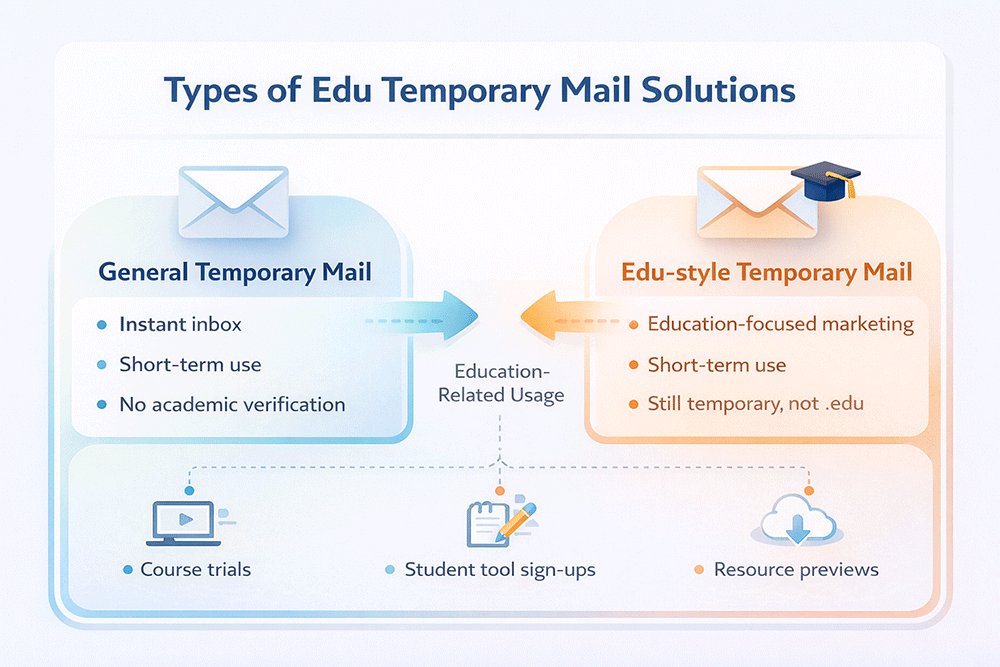
While the term is informal, students generally encounter two broad categories of solutions:

  • General temporary email services
    These generate instant inboxes for short-term use and are commonly applied to education-related sign-ups that do not require academic identity verification.
  • “Edu-style” or education-marketed services
    Some providers market themselves toward students or learning use cases, but still operate as temporary email tools rather than issuing real .edu addresses.

When choosing a solution, students should focus less on labels and more on standards: a clear privacy policy, minimal data retention, reliable message delivery, and transparency about limitations. These criteria matter far more than whether a service uses “edu” in its name.

Types of edu temporary mail solutions
By understanding what edu temporary mail actually represents—and why students search for it—readers can move beyond confusion and begin evaluating when temporary email genuinely fits their education-related needs. This clarity sets the foundation for deciding where temporary email is useful, and where it should be avoided altogether.

Common Education Scenarios That Require Email Verification

Once students understand what edu temporary mail actually refers to, the next question is practical: where does email verification appear in real education-related scenarios?
In modern digital education, verification is no longer limited to formal school systems. It now spans online learning, student tools, academic communities, and even campus-related services.
Below are some of the most common situations where students are asked to verify an email address—and where temporary email may be considered in low-risk contexts.

Temporary Email For Online Courses & Learning Platforms

Online learning environments are one of the most frequent sources of education email verification. Many platforms require an email address before granting access to content or features.

Common examples include:

  • Massive Open Online Courses (MOOCs)
  • Free course previews or trial lessons
  • Sign-ups for learning tools integrated into courses

Typical benefits for students in these scenarios:

  • Quick access to course materials without long-term commitment
  • Reduced inbox clutter from promotional follow-ups
  • Faster evaluation of whether a course meets learning needs

In these short-term learning scenarios, edu temporary mail can serve as a practical and privacy-conscious option for initial access.

Temporary Email For Student Tools & Productivity Apps

Beyond courses themselves, students increasingly rely on digital tools to support studying, collaboration, and organization. Many of these tools require email verification before use.

Common categories include:

  • Note-taking and organization tools
  • AI-powered study assistants
  • Group collaboration and project management platforms

Why students hesitate to use their primary email:

  • Tools are often tested briefly before adoption
  • Some services send frequent update or marketing emails
  • Students may experiment with multiple tools in a short period

For testing and evaluation purposes, edu temporary mail may be used as a safe alternative in education-related tool sign-ups.

Temporary Email For Academic Communities & Educational Resources

Education email verification is also common in academic spaces that focus on discussion, knowledge sharing, or access to learning materials.

Typical scenarios include:

  • Student forums or discussion communities
  • Research previews and early-access academic content
  • Downloadable study guides, papers, or learning resources

In these cases, email verification is often used to:

  • Limit automated abuse
  • Track access to shared materials
  • Manage short-term memberships

When access is informational rather than identity-based, edu temporary mail can help students explore resources without linking them to a permanent inbox.

Temporary Email For Campus and Research Activities

Some campus-adjacent or research-related services also rely on email verification, especially for limited or trial access.

Examples include:

  • Temporary access to digital libraries or archives
  • Academic collaboration tools for short-term projects
  • Research participation sign-ups or surveys

These activities may not always require a verified .edu identity, but still ask for an email address to manage access or communication. In such limited-use cases, edu temporary mail can be considered as a short-term solution, provided no academic records or long-term access are involved.

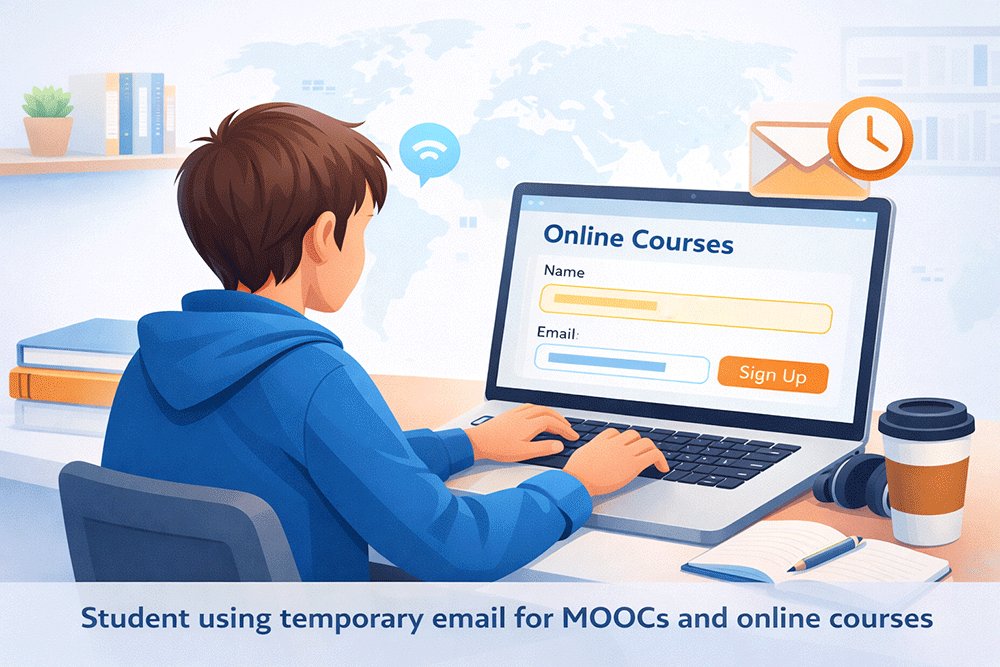
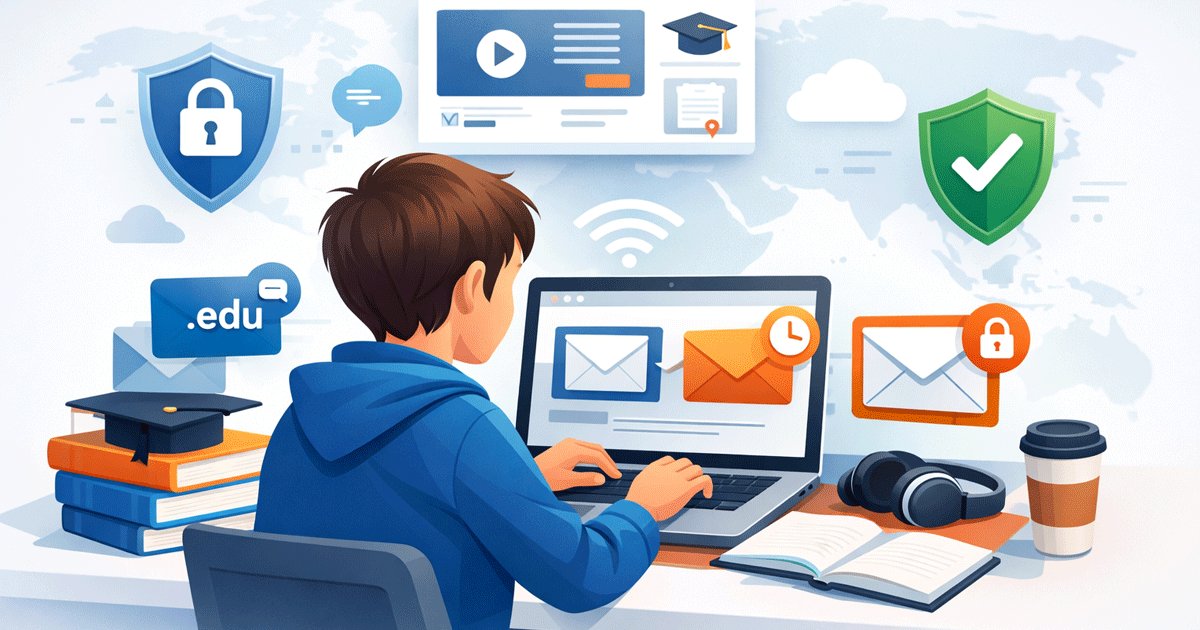
Student using temporary email for MOOCs and online courses

Across all these scenarios, the pattern is consistent: email verification is widely used in education, but not every situation requires a permanent or institutional email address. Understanding where verification appears helps students evaluate whether temporary email fits the context—or whether a more stable solution is needed.

In the next section, we’ll look more closely at when temporary mail is a smart choice for students, and what conditions make its use appropriate in education-related environments.

When Temporary Mail Is a Smart Choice for Students ✅

Not every education-related email verification carries the same level of importance. After understanding where verification appears, the next step is knowing when using temporary mail actually makes sense—and when it doesn’t.

In general, temporary email can be an appropriate choice for students when the scenario meets all of the following conditions:

  • One-time access rather than ongoing communication
  • Short-term testing or evaluation
  • Non-identity-based use, where no academic record is involved
  • No academic or financial consequence if access is lost

When these criteria are met, temporary email becomes a practical tool rather than a risky shortcut.

Common Student Scenarios Where Temporary Mail Works Well

Students most often use temporary email successfully in situations such as:

  • Course trials and previews
    Exploring syllabi, sample lessons, or introductory content before committing to a full course.
  • Educational resource downloads
    Accessing study guides, whitepapers, or learning materials that require email verification but no long-term account.
  • Student tool testing
    Trying note-taking apps, AI study assistants, or productivity tools to evaluate usefulness before adoption.
  • Education-related event registration
    Signing up for webinars, workshops, or short-term learning events that do not require ongoing participation.

In these cases, student tempmail course trials or similar short-term access can save time while keeping a primary inbox clean.

Why This Approach Is Smart for Students

When used in the right context, temporary mail offers several clear advantages:

✅ Better privacy control — your main email stays separate
✅ Lower long-term risk — no dependency on a disposable address
✅ Faster experimentation — quick access without account maintenance
✅ Less inbox noise — fewer follow-up emails from unused services

The key is intentional use: temporary email works best when the goal is exploration, not continuity.

How to Use Temporary Mail Responsibly (Quick Guide)

To stay on the safe side, students should follow a simple process:

  1. Choose a reliable provider
    Look for clear privacy policies, minimal data retention, and stable delivery.
  2. Generate an address for a single purpose
    Avoid reusing the same temporary inbox across multiple platforms.
  3. Complete the verification promptly
    Most education platforms send verification emails immediately.
  4. Do not link personal or academic data
    Keep usage limited to non-critical access only.

For example, services that offer an instant inbox with no registration and fast delivery can be helpful for receiving verification messages quickly—without creating a permanent account. The goal is convenience without commitment.

Used this way, temporary mail becomes a smart, low-risk option for students navigating modern education platforms. In the next section, we’ll look at the opposite side of the equation—when edu temporary mail should be avoided, and why knowing these limits matters even more.

When to Avoid Using Edu Temporary Mail in Education: Key Risks 🚫

Understanding when temporary mail works is important — but knowing when it doesn’t is even more critical.

While edu temporary mail can be useful in short-term, low-risk education scenarios, there are situations where using a temporary email introduces unnecessary risk. In these cases, convenience should never outweigh stability, accountability, or long-term access.

As a general rule:

If an email address is tied to your academic identity or long-term access, temporary mail is not the right tool.

Below are the most important scenarios where students should avoid using temporary email in education-related environments.

1. Official School and Institutional Accounts

Temporary email should never be used to register or manage official school systems, including:

  • University or college portals
  • Student information systems
  • Learning management systems tied to enrollment

These accounts often serve as a gateway to multiple services. Losing access to the email address can mean losing access to the account itself, with no reliable recovery option.

Better alternative:

Use your official school email or a long-term secondary inbox that you fully control.

2. Grades, Credits, and Academic Certificates

Any platform or service connected to academic outcomes requires a stable and recoverable email address, such as:

  • Course completion records
  • Academic credits or transcripts
  • Certificates issued after assessments

Temporary email is not designed for persistence. If access expires, verification messages, updates, or recovery emails may be permanently lost.

Potential consequences:

  • Loss of proof of completion
  • Inability to retrieve certificates
  • Complications in academic verification

3. Tuition, Financial Aid, and Payment-Related Services

Education-related financial systems rely heavily on email communication for security and documentation.

This includes:

  • Tuition billing systems
  • Scholarships or financial aid portals
  • Payment confirmations or account notices

Using edu temporary mail in these contexts increases the risk of missed communications or account access issues, which can have real financial consequences.

Better alternative:

Always use a permanent, secure email address for any education-related financial activity.

4. Long-Term Enrollment or Ongoing Programs

Temporary email is unsuitable for situations that require ongoing participation, such as:

  • Multi-week or multi-month courses
  • Degree programs or certifications
  • Research projects with extended timelines

Long-term enrollment assumes continuity. A disposable inbox works against that expectation and may lead to account disruption if verification or communication is required later.

Why These Limits Matter

Education platforms are built around trust, continuity, and accountability. Using temporary email outside of its intended scope can result in:

  • Account access issues
  • Data loss or missed communications
  • In some cases, account restrictions or suspension
  • These risks are not the result of misuse by students, but of applying the wrong tool to the wrong situation.

By clearly separating short-term access from long-term academic identity, students can use temporary mail responsibly—without compromising their education or privacy.

With these boundaries in mind, the next step is understanding how temporary mail compares to official academic email addresses, and why the two are not substitutes, but tools for very different purposes.

Edu Temporary Mail vs. .Edu Email Address: Comparison for Students

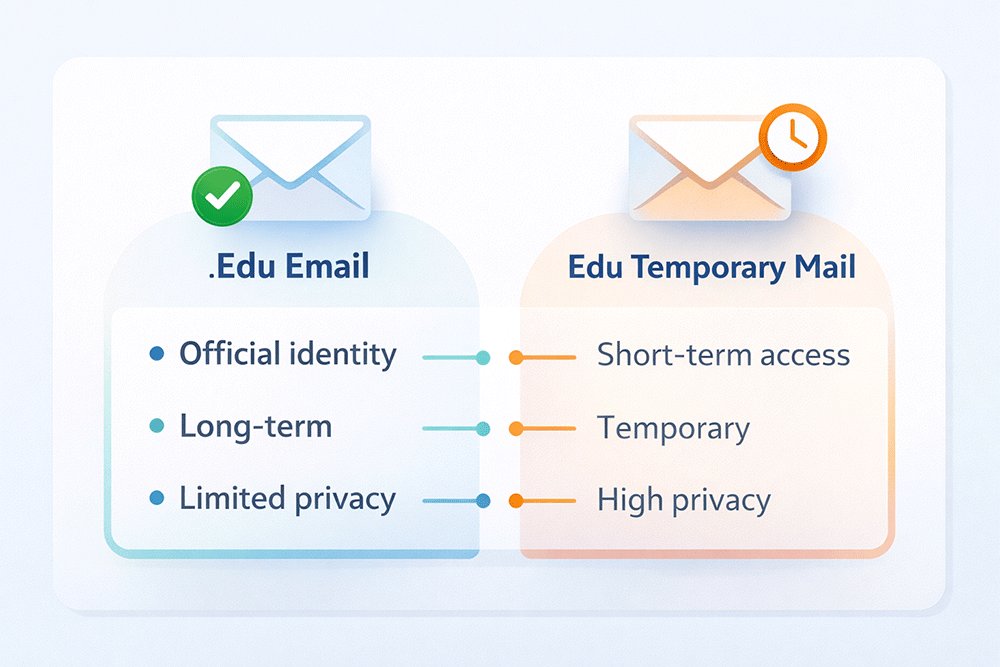
Understanding the difference between a .edu email address and edu temporary mail is key for students navigating education-related platforms. While both involve email in an academic context, they serve very different purposes.

Aspect .Edu Email Edu Temporary Mail Education Compatibility Cost
Purpose Official identity Short-term access High School-provided / Free
Duration Long-term Temporary Medium Free / Low-cost
Privacy Limited High Medium Free / Minimal data collection
Risk if lost High Low Medium Free / Low maintenance
Suitable for trials ❌ ✅ Medium Free

Key Takeaways

  1. Different Use Cases
    • .Edu email is intended for official academic communication and permanent access.
    • Edu temporary mail is designed for short-term or one-off use in education-related scenarios, such as course trials, student tool testing, or resource downloads.
  2. Complementary, Not Substitutable
    • Temporary email is not a replacement for an official academic email.
    • Students can use temporary mail to protect privacy or test new platforms, while retaining their .edu email for critical academic functions.
  3. Cost and Accessibility Advantages
    • Temporary email services are often free, instantly available, and require no registration.
    • Official .edu emails are provided by institutions and tied to enrollment, limiting accessibility to enrolled students only.

Edu temporary mail concept diagram for students

By understanding these differences, students can make informed decisions about when to use temporary email and when to rely on their official academic accounts. This clarity helps balance convenience, privacy, and responsibility—ensuring that temporary email is applied appropriately without compromising long-term academic access.

How to Use Temporary Mail Safely in Education Scenarios

Once students understand when temporary email is appropriate, the next step is using it responsibly. Proper usage ensures privacy is protected while minimizing risk to academic accounts or personal data.

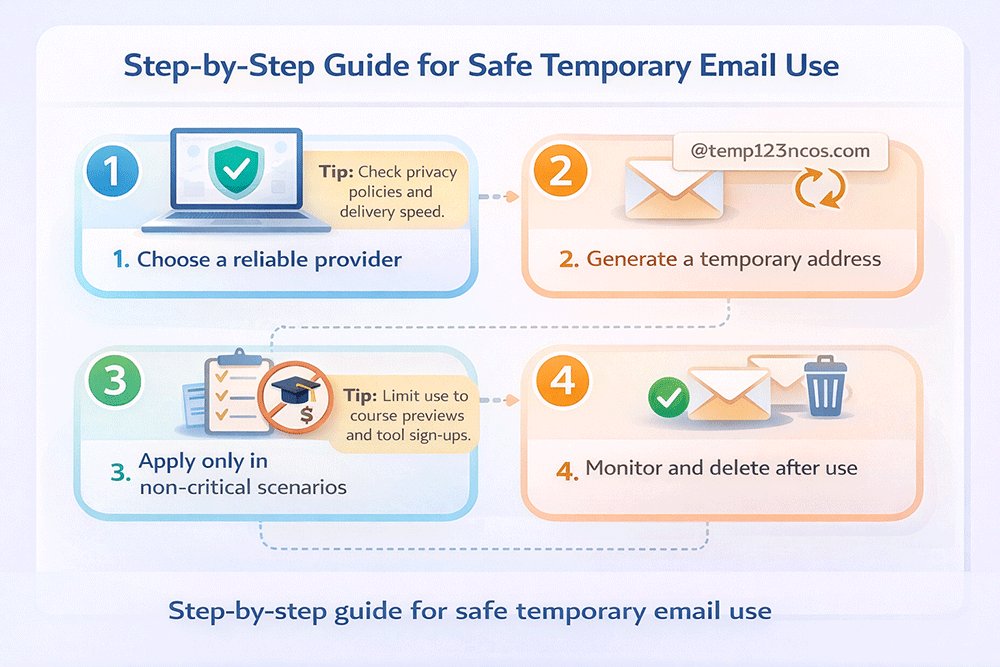
Step-by-Step Guide for Safe Use

  1. Choose a reliable temporary email provider
    • Look for services with clear privacy policies, minimal data retention, and fast delivery.
    • Examples include instant inbox services that do not require registration and support one-time verification.
    • ✅ Tip: Combine with a VPN for additional privacy when signing up for education-related platforms.
  2. Generate a temporary address for a single purpose
    • Create a new email address specifically for one course trial, tool test, or event registration.
    • Avoid reusing the same address across multiple platforms, which can reduce anonymity.
  3. Apply it only in non-critical scenarios
    • Use temporary email for course previews, student tool testing, resource downloads, or short-term event sign-ups.
    • Never use it for accounts tied to grades, financial aid, or official school systems.
  4. Monitor and delete when done
    • Check the inbox to receive verification emails and complete registration.
    • Once access is no longer needed, delete or discard the temporary email to prevent future exposure.

Common Mistakes to Avoid

  • Linking temporary email to personal or academic accounts
  • Using it for financial or identity-critical educational platforms
  • Reusing the same temporary inbox for multiple services
  • Ignoring platform email policies that may block temporary addresses

Step-by-step guide for safe temporary email use
Following these steps ensures that edu temporary mail remains a safe, low-risk tool for students navigating education-related scenarios. By combining careful provider selection, purposeful usage, and proper cleanup, students can maintain privacy without compromising access to learning resources.

Frequently Asked Questions About Edu Temporary Mail

❓1. Can temporary mail replace a .edu email?

No. Temporary email cannot substitute an official .edu address. Use it only for short-term, non-critical access such as course trials, resource downloads, or student tool testing. Always retain your official academic email for grades, transcripts, or financial accounts.

❓2. Will education platforms block temporary email?

Some platforms detect and restrict temporary emails to prevent abuse. If your email is blocked, consider using a reliable service with strong delivery records or contact support for guidance. Avoid repeating temporary addresses for critical platforms.

❓3. Is it legal to use temporary email for courses?

Yes, using temporary email for educational trials or previews is generally legal. The key is to respect platform terms of service and avoid misuse. Only use temporary emails in scenarios that do not involve identity fraud or bypassing institutional policies.

❓4. Can I receive verification codes with temporary mail?

Yes. Most temporary email services deliver verification codes instantly. Ensure your provider supports fast delivery and avoids excessive downtime. Check the inbox immediately to complete registration before the temporary email expires.

❓5. How do I choose a reliable edu temporary mail provider?

Select a service that offers instant inboxes, minimal data retention, and clear privacy policies. Avoid providers that log user activity or require unnecessary personal information. A reputable service ensures both privacy and usability in education-related scenarios.

❓6. What if a platform blocks temporary emails?

Do not attempt to bypass restrictions. Instead, consider using your secondary permanent email or contact platform support. Temporary email works best in low-risk, non-critical scenarios where verification is required but identity is not tied to long-term access.

❓7. Can temporary email be used for MOOCs and learning tools?

Yes, for previews, trials, or short-term testing of Massive Open Online Courses (MOOCs) and productivity tools. Avoid using it for full enrollment or certificates. This ensures privacy without compromising course outcomes or long-term access.

❓8. Are there risks if I reuse a temporary email for multiple platforms?

Reusing the same temporary email can reduce anonymity and increase inbox clutter. Always generate a unique address for each service to maintain privacy. Delete the email once the intended access or verification is complete.

Edu Temporary Mail: Best Practices and Future Outlook

In summary, edu temporary mail is a tool—not an identity—that empowers students to balance convenience, privacy, and risk in education-related scenarios. By knowing when to use temporary email responsibly, you can explore courses, test learning tools, and access resources without cluttering your main academic inbox.

For privacy-conscious students seeking quick access, a reliable temporary email service like ours offers a practical solution in the right contexts. Looking ahead, AI-enhanced temporary mail for education is on the rise—promising smarter inbox management and automated verification, with the AI email market projected to grow 25% by 2030 according to Statista. These adaptive features, inspired by tools like Google's AI integrations, could tailor workflows for student needs.

  • Top Temporary Mail Providers for Students: Compare options for education use.
  • Temporary Mail Safety Guide: Step-by-step risk avoidance.
  • How to Receive Verification Codes with Temporary Mail: Practical tips for seamless use.

By combining thoughtful usage with these forward-looking tools, you'll maintain privacy and efficiency in your educational journey.Ready to protect your inbox? Generate your free edu temporary mail now!!
Try for free

最新記事

Temp Mail API for Automated Testing: How Developers Use Disposable Inboxes in Modern Workflows
2026年2月12日

Temp Mail API for Automated Testing: How Developers Use Disposable Inboxes in Modern Workflows

Temp Mail for Social Media: Stay Private and Spam-Free When Signing Up Anywhere
2026年2月11日

Temp Mail for Social Media: Stay Private and Spam-Free When Signing Up Anywhere

Temp Mail for Netflix: How to Use a Temporary Email Safely for Account Sign-Up
2026年2月9日

Temp Mail for Netflix: How to Use a Temporary Email Safely for Account Sign-Up

Temp Mail for Facebook: A Complete Guide to Privacy-Safe Signup in 2026
2026年2月7日

Temp Mail for Facebook: A Complete Guide to Privacy-Safe Signup in 2026

目次

  • What Is Edu Temporary Mail and Why Do Students Search for It?
  • Common Education Scenarios That Require Email Verification
  • When Temporary Mail Is a Smart Choice for Students ✅
  • When to Avoid Using Edu Temporary Mail in Education: Key Risks 🚫
  • Edu Temporary Mail vs. .Edu Email Address: Comparison for Students
  • How to Use Temporary Mail Safely in Education Scenarios
  • Frequently Asked Questions About Edu Temporary Mail
  • Edu Temporary Mail: Best Practices and Future Outlook
Temp mailに戻る